
×
Filter Results
Filter Results

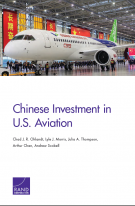
Contracted Research
The report examines Chinese investment in U.S. aviation and related university connections with Chinese entities and assesses the implications of the resulting technology transfer on U.S. national security and aviation industry competitiveness. This report was prepared for the Commission by the RAND Corporation.
Staff Paper
Chinese imports account for a disproportionately high number of product safety recalls in the United States, and China’s position as the largest supplier of U.S. consumer imports challenges U.S. safety regulatory agencies who must apply finite resources to screen out risky products. This staff paper explores unique product safety problems posed by Chinese imports, including legal difficulties associated with holding China-based firms accountable for unsafe products, gaps in China’s safety regulatory structure, and difficulty in identifying Chinese products that have been shipped through third party countries. The report also summarizes U.S. import safety procedures followed by the U.S. Consumer Product Safety Commission and U.S. Food and Drug Administration and the resources available to these agencies to detect unsafe imports.
Staff Paper
Despite areas of tension and distrust between Beijing and Moscow since normalizing relations in 1989, the two countries’ militaries and defense establishments have steadily worked to minimize and overcome these differences and are now experiencing arguably the highest period of cooperation. This staff report analyzes the three main components of military-to-military ties—military exercises, defense industrial cooperation, and high-level military contacts—which show increases in the level and quality of engagement, collectively reflecting closer defense relations. The report also describes the security implications of recent developments in Sino-Russian defense cooperation for the United States and the Asia Pacific.

Research
The U.S.-China Economic and Security Review Commission invites submission of proposals to provide a one-time unclassified report on Chinese entities’ use of the Foreign Sovereign Immunities Act (FSIA). Electronic or hard-copy proposals must be received by NOON (EST) on April 3, 2017.
Staff Paper
High-speed rail is a symbol of China’s technological progress and a significant source of national pride. In under a decade, China built the world’s largest high-speed rail network and developed globally competitive rail companies. Now Beijing is pursuing contracts for high-speed rail projects abroad. This staff report examines China’s high-speed rail diplomacy and growing footprint in the U.S. rail market. China’s initial forays in the U.S. rail market suggest Chinese rail firms have a mixed impact on U.S. industry. The United States does not have a domestic high-speed rail manufacturing industry, but China’s entry into the U.S. rail market could undermine competition by pitting heavily subsidized, state-owned companies against private firms.
Staff Paper
China is an important market for U.S. firms, but policies outlined in the 13th Five-Year Plan seek to create new Chinese competitors that will be able to challenge U.S. companies abroad while slowly closing market opportunities in China for U.S. and other foreign firms in important high-tech sectors such as biopharmaceuticals, robotics, and aviation. This staff report analyzes the 13th Five-Year Plan, the Chinese government’s most important strategy to address its economic, social, and environmental challenges over the next five years, focusing on key national targets (including subsequently announced localization and innovation targets), market access commitments, and its implications for the U.S. employment, innovation, and economic growth.
Issue Brief
In December 2016, Sao Tome and Principe—a country consisting of a group of islands and islets off the western coast of central Africa—broke diplomatic relations with Taiwan, and re-established diplomatic relations with China. The issue brief describes what happened, what it means for Taiwan, and how it fits into a series of measures that Beijing has taken to pressure Taiwan since the election of Taiwan’s President Tsai Ing-wen.
•This is the second time since President Tsai’s election that Beijing has re-established diplomatic relations with one of Taipei’s former diplomatic partners—of which it now has only 21—marking a change in Beijing’s behavior. In 2008, Taipei and Beijing reached a tacit understanding to stop competing for recognition from each other’s diplomatic partners—a “diplomatic truce.” During the period that followed, Beijing also rejected overtures from several of Taiwan’s diplomatic partners to establish diplomatic relations with China.
•Taiwan’s diplomatic relationships are significant for symbolic and practical reasons. Although, Taiwan almost certainly gains more from its unofficial relations with countries that have extensive international influence, such as the United States, diplomatic relations are an important component of Taiwan’s toolbox for maintaining a presence on the international stage.
•Despite President Tsai’s pragmatic approach to cross-Strait relations and attempts to compromise, Beijing views her with suspicion due to her unwillingness to endorse the “one China” framework for cross-Strait relations. Other measures that Beijing has taken to pressure Taipei since President Tsai’s election include suspending official and semiofficial cross-Strait communication and meetings and excluding Taiwan from meetings of international organizations, among others.